Loading basket...



Can MR16 light bulbs be swapped for Coloured versions?
The thing with MR16 bulbs is that most people tend to think they are all the same, and one can replace another unless one starts thinking about colored versions-then quite a few practical questions arise. Let's break it down in plain, everyday language and make sure you know just what is safe, compatible, and what to expect when you make the switch.
Can MR16 light bulbs be swapped for Coloured versions?
You can swap out a normal MR16 with a colored MR16, but the new light bulb does need to have basically the same requirements as the base type, usually GU5.3, with the same voltage and a power rating that your fixture can handle. Voltage is an important consideration here: many MR16 light bulbs run on 12V and use a transformer. Unfortunately, some colored MR16 LEDs don't work well with older magnetic or electronic transformers, either flickering or refusing to turn on at all. So before you hit the switch, make sure your transformer is actually LED-friendly.
If it's not, you'll have to replace the transformer or else use a colored halogen MR16 instead - though those are being phased out in many locations. Once the basics line up, however, colored MR16 bulbs are an easy way to change the mood of a room without touching wiring or fixtures. You just twist the old one out, push the new one in.
Can you change MR16 to LED?
You can, and most do, as LED MR16 bulbs run cooler, last longer, and cut your power bill. Again, the trick is in the transformer: halogen MR16s draw more power, so when you swap to LED, that low load can confuse older transformers. That's when you get buzzing or flashing. So if you experience this issue, the long-term solution is to replace the transformer with an LED-compatible driver.
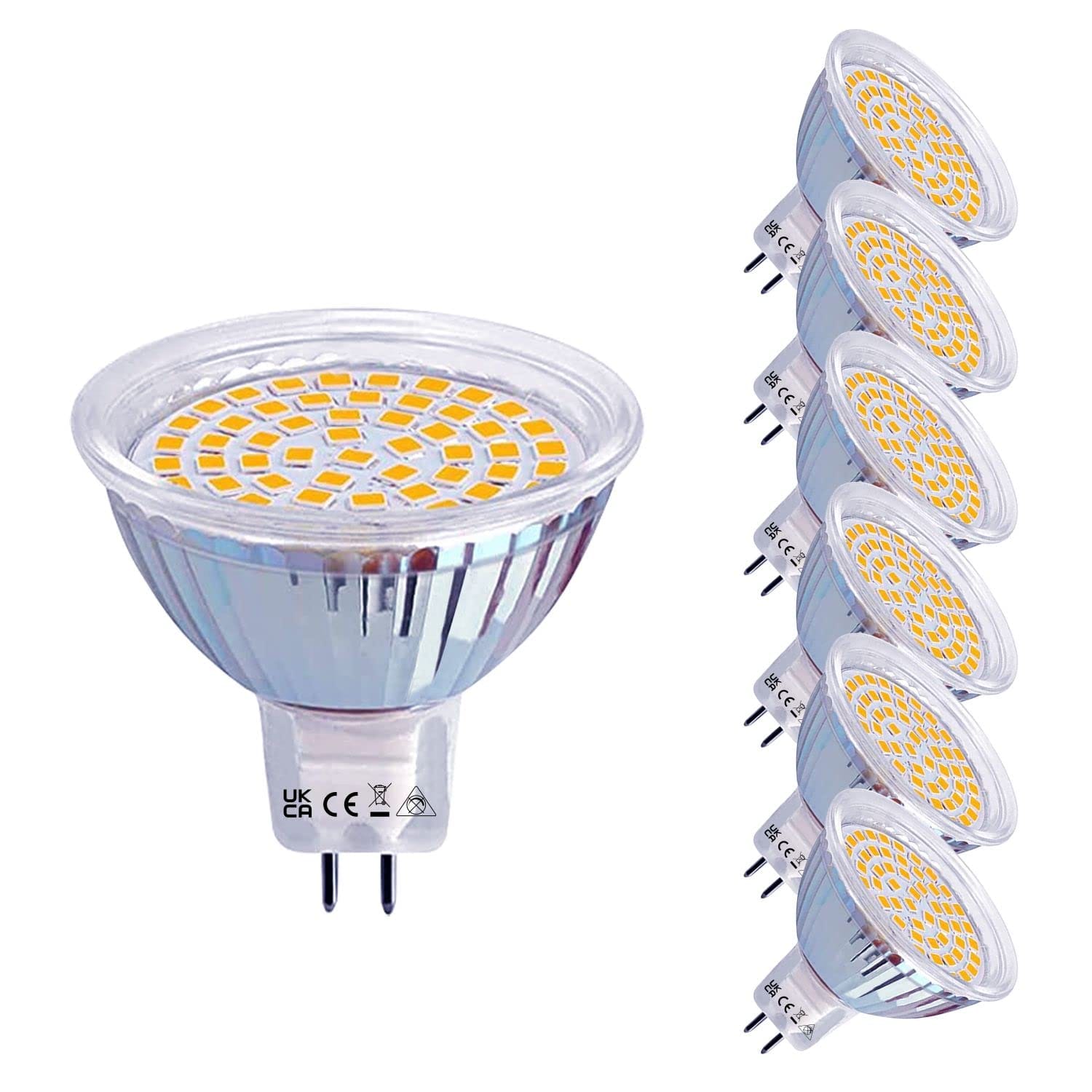
Assuming your lights are running off a modern electronic transformer that's capable of handling low-watt LEDs, the upgrade is often painless: just plug in the LED MR16, turn it on, and you get brighter light with far less heat. Yes, you can make the swap, but just because you can doesn't mean you should assume the transformer will always play along.
Are all MR16 bulbs the same?
Well, not really; speaking physically, they can be the same shape and size, but on the inside, that's a different story. Here is what differs:
Voltage: Depending on the model, either 12V or 240V may be used, but mixing them up may blow the bulb or damage the fixture.
Base Type: GU5.3 is the base type for most MR16 light bulbs, but not all.
Beam Angle: narrow spotlights versus wide floods.
Technology: Halogen or LED. They act differently with heat, dimmers, and transformers.
Color Output: warm white, cool white, RGB, or fixed colors.
Similar but not interchangeable in all applications. When someone hands you an MR16 and says, "This fits anything," well, take that with a pinch of salt.
Can LED bulbs change color?
Many can, but not all. You have three types in the market.
Fixed colour LEDs: Remain a single colour - red, blue, green, etc
Tunable white LEDs come in a color temperature range from warm white to cool white.
RGB or RGBW LED lights: These change to virtually any color you may want. They are generally operated by a remote, an app, or via a smart home system.
If you buy a colored MR16 LED that's supposed to cycle through colors and you expect it to happen automatically, well, it has to even support RGB. Many of the more budget-friendly MR16 LEDs are single color only. And if it is an RGB MR16, then check to see if your transformer supports smart bulbs. Smart bulbs tend to be quite finicky.
Can I use GU5.3 instead of MR16?
Many people get this part confused, since the names sound similar. Here's the difference:
MR16 describes the shape and size of the bulb.
GU5.3 actually refers to the spacing of the pins on the base.
Most MR16s are installed in a GU5.3 base, but not all GU5.3 bulbs are technically MR16s. If your fixture says it accepts MR16 GU5.3 bulbs, then sticking with GU5.3 is usually fine – but only if the bulb also matches the same voltage.
If it expects a 12V MR16, then you must also use a 12V GU5.3 bulb. You can't fit a 240V GU5.3 LED into a 12V system; it won't work and could be dangerous. The answer is yes, you can use GU5.3 instead of MR16, provided the electrical specifications match exactly.
Can I replace MR16 with GU10?
No, not directly; they are different systems altogether.
The MR16 bulbs take a push-fit two-pin connection, usually GU5.3, and usually run at 12V.
The GU10s feature a twist-and-lock base and almost invariably run on 240V mains power.
So, to replace an MR16 with a GU10 is not just a matter of buying another bulb. You would need:
- A new GU10 lamp holder
- The transformer is to be removed.
- Any rewiring to the main voltage should be
- done by a suitably qualified electrician.
Once you have rewired the fitting for GU10, you can never go back to MR16. People mainly go for this change when they are tired of using transformers and want to make their lives simpler.
Final Thoughts
Replacement of MR16s with colored ones is usually quite easy if you keep the very basics in mind: voltage, base type, transformer compatibility, and whether you want fixed or color-changing LEDs. Once those boxes are checked, colored MR16s are a fast way to freshen up a space without touching the wiring or replacing the whole fixture.
Created by Vaibhav Gupta on 14th November, 2025
Author
| | Vaibhav Gupta
|


IAN LINDSAY
11th May 2026
Excellant experiance, quick delivery. Appreciated the personal contact with valued advice, very much appreciated. I would use again.
Helen Zavros
11th May 2026
I was unsure which bulb to purchase and after calling for assistance the seller gave me some advice and was extremely helpful thanks again