Loading basket...



What Are Dichroic Light Bulbs and How Can I Tell Them Apart from an Ordinary Lamp?
The term "Dichroic" refers to a specialised optical coating that is put onto a reflector lamp enabling it to transmit and reflect light based on wavelength. This technology allows the bulb to manage heat and color much more effectively than standard incandescent or halogen lamps.
How Dichroic Filters Work
The dichroic filter is a thin-film coating usually applied to the inside of the glass reflector. The coating is composed of multiple layers with varying refractive indices. The thickness and number of these layers are precisely controlled to create an interference effect helping them to manage heat.
Instead of absorbing unwanted wavelengths that generate heat, the dichroic filter reflects specific wavelengths while allowing others to pass through. This coating on the lamps is designed to reflect visible light forward whilst allowing infrared (IR) radiation/heat to pass backwards, away from the lamp.

Advantages of Dichroic Bulbs
- Heat Management (Cool Beam Technology): By allowing the infrared heat to radiate behind the light fixture, the beam of light directed onto a particular item or room is significantly cooler. This makes them ideal for applications where heat damage or fading is a potential concern.
- Precise Color Control: The selective reflection/transmission allows manufacturers of these lamps to finely tune the color temperature of the light to create a specific color output (often a bright crisp white) without relying on colored glass or gels.
- High Beam Intensity: As these bulbs reflect all desired visible light wavelengths forward, the dichroic reflectors focus the light into a tightly controlled and intense beam which makes them very effective for spotlighting.
Telling Dichroic Bulbs Apart from Ordinary Lamps
Identifying a dichroic bulb from a standard incandescent or halogen lamp is fairly straightforward and can be done via a visual inspection and looking at the functional differences.
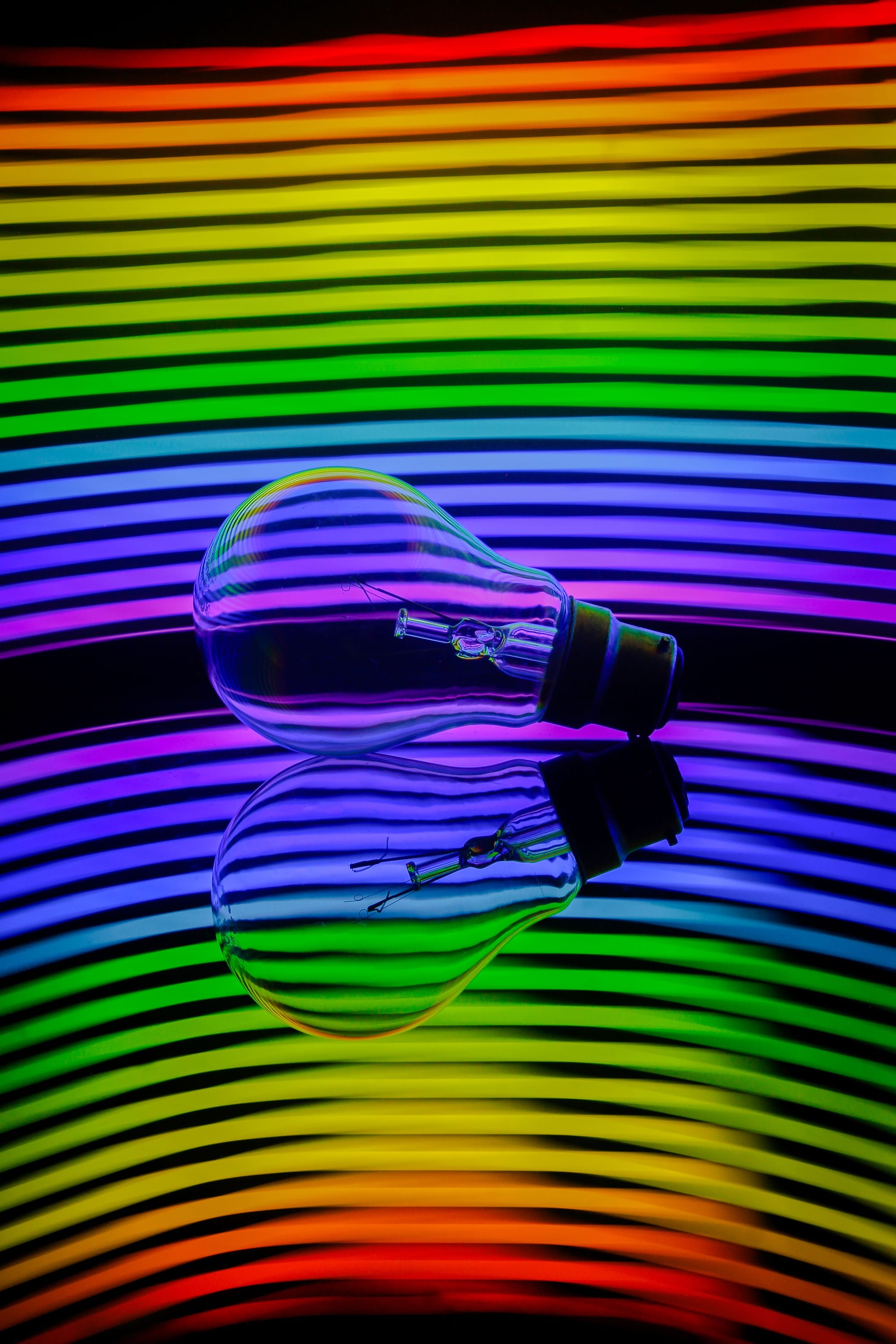
- Appearance of the reflector glass: Dichroic lamps will often have a distinctive mirror like sheen to them whilst an ordinary halogen or incandescent lamp will normally have a silver or aluminium reflector lens which is opaque.
- The Key Test (i.e. light transmission): If you shine a flashlight through the back of the reflector lens light will pass through its coating and will show a different colour to the emitted light.
- Heat Emission: The front of light and the beam will be noticeably cooler than a standard lamp of the same wattage but the back of the lamp will be hotter than it’s non dichroic counterpart.
- Description: A dichroic lamp will be labelled as “dichoric”, “cool beam” or “IR-Coat.” An ordinary or incandescent lamp will not have this labelling and will just list the wattage and shape such as “35w MR16.”
Can LED Bulbs Be Dichroic?
The term "dichroic" refers to the coating on a traditional halogen bulb's reflector which is used primarily for managing heat and directing visible light. However, the main function of a dichroic filter which is the selective wavelength transmission/reflection via thin film is something that can be applied and used in LED technology.
When the term dichroic is applied to LED lamps, it usually refers to one of two things:
- Aesthetics and Form Factor: Many modern LED MR16 or MR11 bulbs are designed to visually look the same as a traditional halogen dichroic lamp. These LED bulbs are sometimes called "LED dichroics" because they fit into the same fixtures designed for dichroic halogen bulbs. They will often have the same physical shape and beam angle as the LED bulbs are designed to be replacements for the halogen bulbs. For a LED version the heat management is handled by internal heat sinks rather than a specialized coating on the reflector of the lamp.
- Internal Optical Components: Dichroic filters are used within some LED systems for color mixing and beam shaping, particularly in high-end stage lighting and architectural lighting. Tiny dichroic filters and mirrors are used to separate and recombine light components (e.g., red, green, and blue LEDs) to achieve precise color outputs.
In summary, the term "dichroic" when talking about a halogen lamp is referring to the coating for heat reduction. When it is applied to LED lamps this refers to their appearance and physical form or it is for the use of complex dichroic optics inside the fixtures to control light color and quality.
Created by Adonia Watt on 27th January, 2026
Author
| | Adonia WattI have worked as a customer service representative at BLT Direct since 2018. My skills and knowledge have continued to develop from this point leading me to making contributions on the website. |


Maureen Paine
16th October 2026
Quick & easy to order.
John Willis
13th October 2026
Have used for many years. Always excellent service and range