Loading basket...



What IP Rating Do I Need for Bathroom Lighting?
Choosing the correct IP rating for bathroom lighting is extremely important for health and safety compliance. Bathrooms are areas where water and electricity are in close proximity to each other meaning that any lighting products must be suitable for damp or wet conditions.
IP stands for Ingress Protection. An IP rating lets us know how resistant a product is to dust and moisture. The rating usually has two numbers which follow after IP such as IP44 or IP65. The first digit refers to protection against solid objects and dust and the second digit refers to protection against water.
For bathroom lighting you should pay particular attention to the second digit as this will tell you how well the fitting can withstand moisture or water splashes.
Bathroom Zones
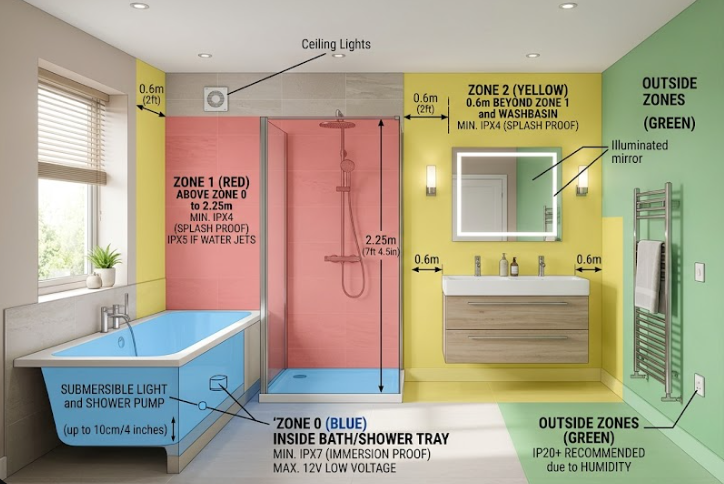
Bathrooms are divided into different electrical zones based on their proximity to a water source. Each zone will require a different IP-rated lighting for any lighting.
Zone 0 refers to the inside of the bath or the shower. Any lighting installed in these areas must be low voltage and rated IP67 at minimum. This rating means that the fitting will be protected against temporary immersion in water.
Zone 1 is the area directly above the bath or shower up to a height of 2.25 metres from the floor. In this zone all lighting should be rated IP65. An IP65 rating means the fitting is protected against water jets and is suitable for areas exposed to direct splashing.
Zone 2 refers to the space 0.6 metres horizontally beyond the bath or shower area and more than 2.25 metres above it. In this zone any fittings installed should have a minimum rating of IP44. IP44 fittings are protected against water splashes.
Areas outside of these zones do not legally require a specific IP rating in some regions but it is still strongly recommended to use at least IP44 rated fittings throughout bathrooms to be absolutely sure that they are safe.
How does this relate to the lights within my bathroom?
Steam and condensation are also important factors as these both lead to excess moisture. Bathrooms often experience high humidity levels and this can damage unsuitable lighting over time. Using properly rated fittings will help to prevent moisture ingress, corrosion, and electrical faults.
When you are choosing bathroom lighting it is important to consider the intended location carefully. Ceiling spotlights above a shower will require higher protection than decorative wall lights near a vanity mirror for example. People will sometimes use an outdoor-rated light fitting for a bathroom as they often provide suitable water resistance. While this is a valid thing to do you should still double check the IP rating to make sure it will be suitable.
You should also keep in mind that bathroom mirrors with integrated LED lighting will also require appropriate moisture protection. Many illuminated mirrors are rated IP44 or higher but it is again worth double checking.

Summary
Using the correct IP rated bathroom lighting ensures compliance, improves safety, and helps protect fixtures from moisture-related damage. The appropriate IP rating will depend on the zone the light is being installed in. If you are unsure which IP rating is required for your bathroom project we would strongly recommend that you consult a qualified electrician.
Created by Adonia Watt on 28th May, 2026
Author
| | Adonia WattI have worked as a customer service representative at BLT Direct since 2018. My skills and knowledge have continued to develop from this point leading me to making contributions on the website. |


Louise Graham
7th October 2026
Excellent customer service throughout and great products
Tammy Fernando
7th October 2026
Great service! Really supportive of all my questions in my journey to go from LED (bad for our health) to incandescent lighting. Thank you so much! Tammy