Loading basket...



Are LED/CFL Candles the same size as old-style types?
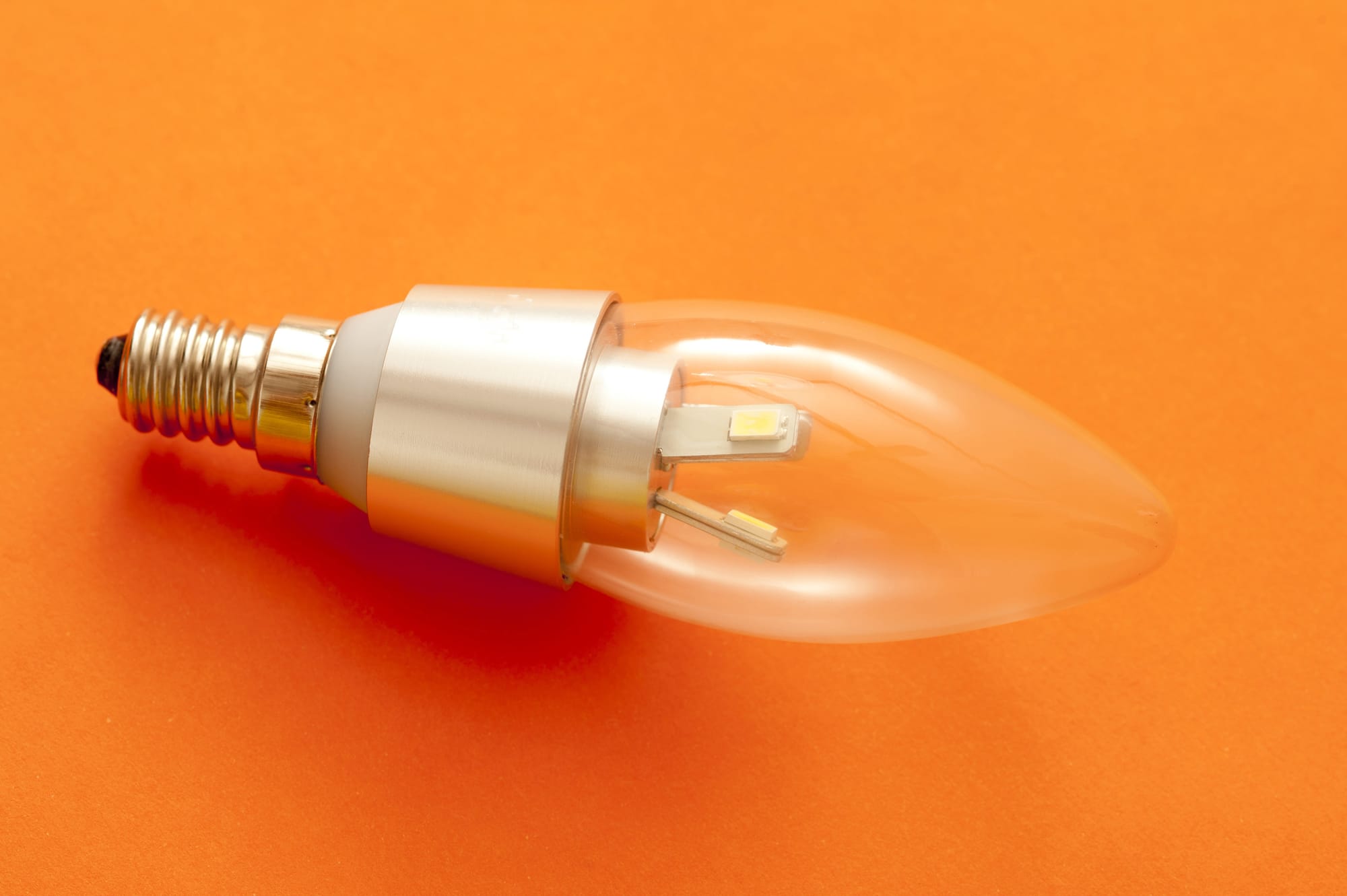
Short answer: No. Physical shape and size of LED or CFL "candle" bulbs can differ from standard incandescent candle-shaped bulbs, so you'll need to double-check size and style of base when substituting. Older incandescent candle bulbs, for example, may be a little narrower in shape and use some other form of filament than newer "LED candle" bulbs.
Let's run through the related questions you posed a bit more systematically.
Are CFL and LED bulbs interchangeable?
Yes, but mostly you can replace a CFL (compact fluorescent light) with an LED (light-emitting diode) bulb, but there are some things you have to think about.
1. The Socket & Base: If your fixture has a CFL with a simple to screw-in base or two-pin plug-in type, the replacement LED will require that base. Without it, it just won't fit physically.
2. Ballast and Fixture Style: Not related to the candle style of light bulbs but some CFLs have a built-in ballast (such as plug-in fixtures or 2-pin/4-pin CFLs). When you replace an LED that does not require the ballast, you will be requested to skip the ballast. You can create flicker or reduced lifespan when you combine an LED with a CFL ballast.
3. Wattage and Heat Problems: Although LEDs consume far less power, the light could include a "max wattage" label because of outdated technologies.
4. Colour and Light: LED replacement should be identical lumens (light) and proper colour temperature (warm or cold light) as the CFL it is replacing.
So sure, for most general lamp or fixture use, an LED can substitute a CFL — but don't expect "plug and play" for all without checking.
What is the LED equivalent of CFL?
Here's how to estimate: look at how many watts the CFL consumes and then buy an LED that gives the same light (lumens) in fewer watts. Approximately, a ~15-20 W CFL can be swapped out by an ~8-12 W LED.
A ~25-30 W CFL can be replaced with an LED in the ~12-15 W equivalent range.
True wattage depends on the manufacturer, efficiency, colour of light, beam shape, etc.
When buying an established good brand (e.g., Philips LED bulbs), take note of their equivalence rating (e.g., "LED 9 W equivalent to 25 W CFL / 60 W incandescent").
Their "Choose a Bulb" page offers a search by equivalent watt capability.
Then the selection: pick the LED that says it "replaces" your CFL (or equivalent), and check lumens and base type twice.
Why are the CFL Bulbs being replaced?
There are several reasons that CFLs are now being phased out or discontinued in most markets:
1. They contain mercury. Although CFLs don't carry a lot, the fact that each bulb does have mercury creates disposal and environmental issues.
2. They are less effective than LEDs, particularly if you count warm-up time, light loss throughout head-life, etc. CFLs also emit an ugly amount of heat (up to ~80% of their energy in heat form) versus LEDs.
3. Standards and Regulations: European and some US state regulations limiting hazardous substances (RoHS) and other energy-efficiency standards have rendered CFLs unappealing and even legally prohibited in some cases.
4. LED technology also improved and got cheaper to offer improved performance (longer lifespan, cooler operation, more universal shape factor), so the market shifted.
In short, CFL was an upgrade from the incandescent bulb, but LEDs were a superior technology, and the firm had to play catch-up.
What are some of the disadvantages of CFL light bulbs?
There are a number of disadvantages of CFLs over LEDs, sometimes even incandescent. The most significant are the following:
1. Warm-up time and flicker: They all take a few seconds to turn on at maximum light and, in some cases, flicker or pulse.
2. Mercury Content: Also, as explained above, they will contain mercury in them, so there is a safety and disposal issue.
3. Short life and environment/hazard concerns: CFLs have shorter lives as well. For instance, one source estimates the average for CFL at ~8,000 hours and for LED at ~25,000+ hours.
4. Compatibility Issues: Some CFLs will not dim, are not rated for use in enclosed or high ambient-temperature applications. Ballast will be damaged, overheating can occur, and worst-case scenario, fire risk when the incorrect type is installed.
In fact, they were a great idea, but not perfect.
What is the outcome of putting an LED bulb into a fluorescent fixture?
If you have installed a fluorescent tube lighting (or a CFL) but driven it with an LED bulb, then this is what happens and what to expect:
- If the fixture does utilize a ballast for fluorescence (like CFL or fluorescent tube), using an incompatible LED directly installed will result in flicker, reduced life, or no light. LED "drop-in" products are to be used with the ballast, and some are "ballast bypass" (you bypass or remove the ballast and plug directly).
- Heat and ventilation: The fixture was probably originally specified for the thermal character of the existing lamps. An LED can, in a way, be cooler, but when the fixture is sealed and not even designed for LED thermal dissipation (which is another problem), then the LED becomes hot and fails prematurely. One thread had it that LEDs in some sealed fixtures would fail prematurely due to insufficient heat dissipation.
- Spreading of light and beam shape: Fluorescent light spreads in wide angles; LEDs are beam-shaped. If you install an LED short tube or LED retrofit in a fluorescent fixture without concern for beam shape, expect altered lighting patterns or shadowing.
- Warranty and safety intention: If you modify the fixture (by-pass ballast, etc), you will need to wire to local codes, and you don't invalidate the fixture/LED warranty.
So you can put LED replacements in fluorescent fixtures, but compatibility (ballast vs bypass), thermal environment, and physical fit/optics must be checked.
Last Words
If replacement of LEDs with CFLs (or style mixing) is on your mind, here's my two cents:
1. Check base type and size. Mentioning replacement bulbs' "candle shape" or "A-shape" doesn't imply the same physical dimensions.
2. Ensure the LED equivalent is equal to the light output (lumens), not wattage.
3. Ensure fixture/ballast compatibility is being achieved (especially if replacing fluorescent tube or CFL fixtures).
4. Use quality brand names (Philips, Osram, etc), quoting the same wattage, base, colour temperature, and compatibility.
5. Dispose of old CFLs and recycle correctly any bulbs/bases.
Created by Steve Ellwood on 24th July, 2015
Author
 | Steve EllwoodQualified as an Electrician, founder of BLT Direct |


Roberts Brūveris
20th January 2026
Largest bulb collection I have ever seen and the website is great with lots of information to select the right bulb for your needs and easy to use. Prices are also good.
Roger Foster
19th January 2026
Great Product. reliable Service. Many Thanks